WANLONG - Premium Quality 5 Axis CNC Bridge Saw Company: Focus on Precision and Durability

Sep 26, 2026


Quanzhou, Fujian Sep 25, 2026 (Issuewire.com) - WANLONG - Premium Quality 5 Axis CNC Bridge Saw Company: Focus on Precision and Durability Architectural stone processing requires precise dimensional accuracy, compound miter cutting, and smooth edge profiling across ultra-compact sintered stone, quartz, and dense granite slabs. Conventional cutting setups require repetitive manual repositioning and secondary milling stations, which introduces cumulative positioning deviations and risks edge-chipping on delicate stone workpieces. To address cumulative alignment errors and eliminate structural vibration during heavy stone fabrication, Fujian Wanlong Times Technology Co., Ltd. (WANLONG) manufactures high-rigidity premium 5-axis CNC stone cutting machinery designed for uncompromising cutting precision and multi-decade mechanical durability. Operating since 1993, WANLONG integrates five-axis synchronous interpolation, high-speed electro-spindle milling, and custom diamond tooling to execute precision sawing, beveling, routing, and 3D surface profiling within a single automated setup.

The Engineering Challenge: Precision Degradation and Deflection in Multi-Axis Stone Fabrication

The root cause of dimensional inaccuracies and surface chipping during heavy-duty stone processing stems from machine tool structural flexure and mechanical backlash. When circular diamond blades or high-speed milling bits engage dense granite or ultra-compact sintered stone, the cutting interface encounters extreme dynamic resistance. In conventional machinery constructed with lightweight steel fabrications or single-side drive mechanisms, these cutting forces induce microscopic frame deflection and torsional vibration. Over sustained production runs, vibration harmonics accelerate blade runout and cause the cutting line to wander, resulting in wavy cut faces, uneven 45-degree miter edges, and inconsistent seam alignments.
In addition, when conventional three-axis cutters are adapted for complex angular tasks through manual tilting heads, mechanical tolerances inevitably deteriorate. The absence of synchronized multi-axis motion and rigid guidance systems leads to dimensional errors exceeding two to three millimeters across large-format architectural slabs. In high-end residential interiors and commercial facades, such discrepancies require costly manual grinding and corrective polishing on the job site. Industrial stone fabricators therefore require a dedicated machine platform that combines uncompromising static rigidity with backlash-free multi-axis kinematics to maintain repeatable accuracy.

Kinematic Rigidity and Backlash-Free Motion: Deconstructing the CNC-5 JET Architecture

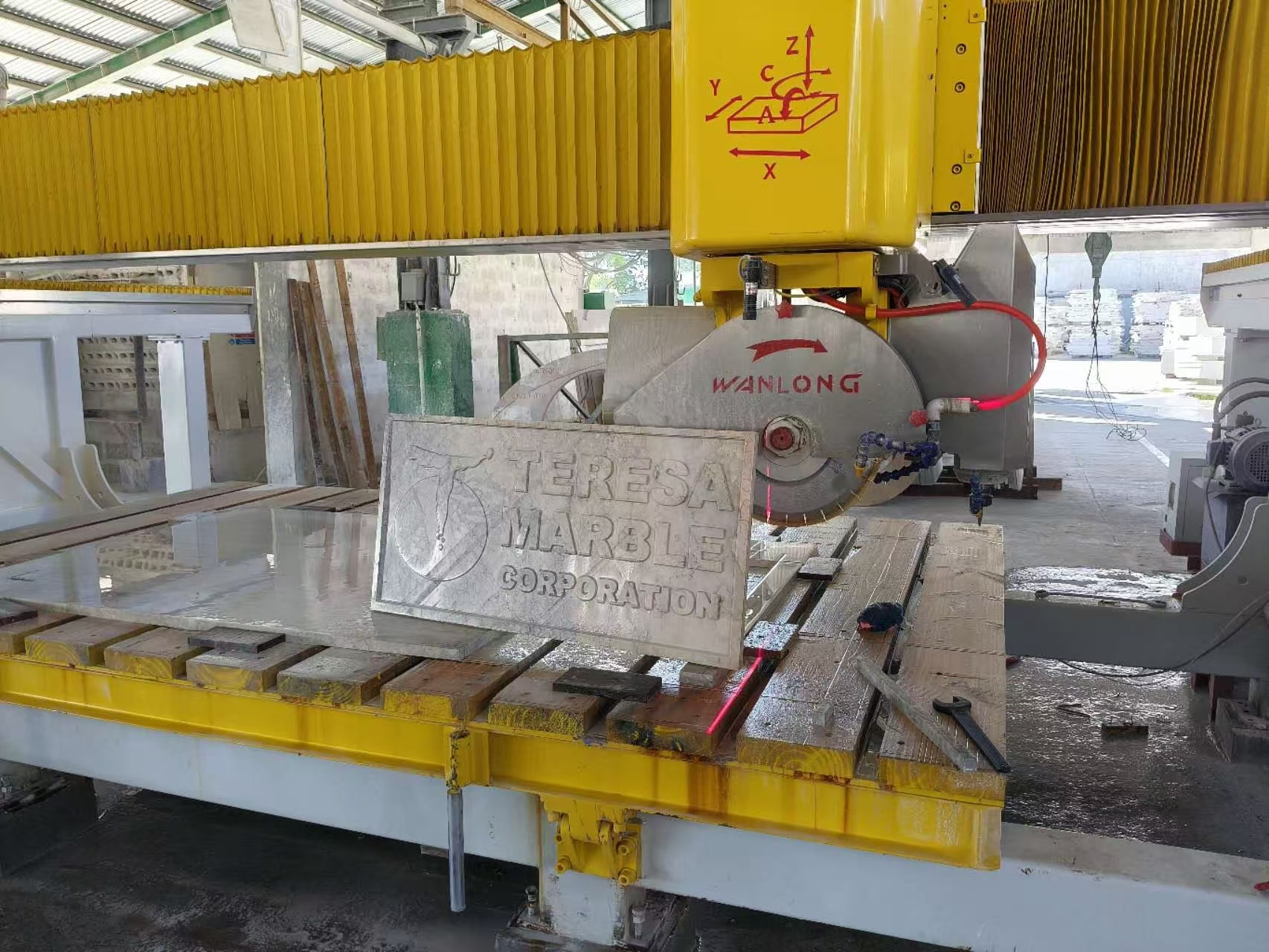
To address structural deflection and eliminate positioning drift, Wanlong Times Technology Co., Ltd. (Wanlong Group) engineered the CNC-5 JET five-axis bridge cutting and milling machine. As a leading stone machinery innovator, WANLONG builds the CNC-5 JET upon a heavily ribbed, stress-relieved monoblock chassis engineered to absorb dynamic cutting loads. The heavy-duty structural frame effectively neutralizes cutting vibrations, isolating the bridge and toolhead assembly from external resonance. This rigid structural foundation maintains precise spatial geometry under aggressive tool feeds. As a direct result, the machine preserves its mechanical alignment through decades of intensive industrial use.
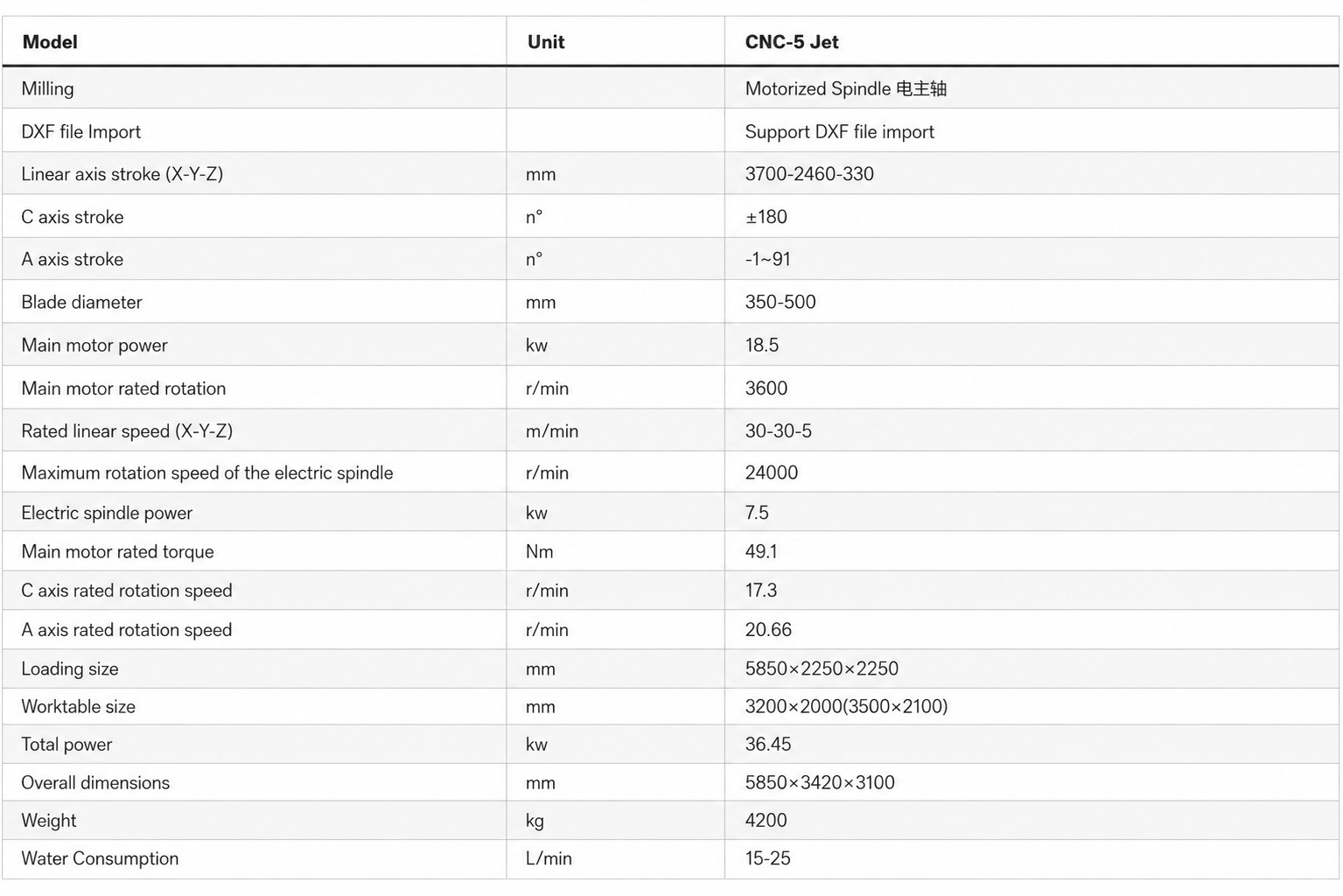
The mechanical envelope of the CNC-5 JET provides expansive operational freedom, featuring linear axis travels of 3700 mm along the X-axis, 2460 mm along the Y-axis, and 330 mm along the vertical Z-axis. This spacious workspace accommodates oversized architectural slabs and thick stone blocks without kinematic restrictions. To guarantee absolute positional tracking across long spans, the Y-axis utilizes a synchronized dual-drive configuration engineered with zero-backlash mechanical couplings. By driving both bridge supports simultaneously through precision-ground helical racks and high-load linear guide rails, the dual-drive system eliminates gantry racking and twisting during rapid movements. This advanced mechanical arrangement consistently achieves a positioning precision of 0.1 mm or lower across the entire worktable.

Digital CAM Integration, High-Speed Electro-Spindle Milling, and Vision Systems

Mechanical rigidity is complemented by a sophisticated industrial CNC control system with a responsive touch screen, USB connectivity, and Wi-Fi interface. The CNC-5 JET controller natively supports direct DXF and DWG vector file importation, automatically optimizing five-axis toolpaths for automated angle beveling, one-click orthogonal vertical/horizontal cutting, and smooth arc profiling. Standard automatic blade diameter measurement safeguards cutting depth accuracy, while the high-speed, high-efficiency electro-spindle alternates between diamond circular blades for sawing and high-precision diamond bits for sink routing and bas-relief milling.
To provide comprehensive process oversight and meet advanced fabrication requirements, the platform integrates smart operational enhancements. Standard remote real-time camera monitoring keeps operators informed of slab alignment and machine status. Fabricators can also configure application-specific options--including an integrated wide-angle overhead camera, automated slab thickness measurement, and expanded plane engraving with edge profiling packages--tailoring the CNC-5 JET to precise production workflows without surplus hardware overhead.

Superhard Material Synergy: The Integrated Manufacturing Advantage of WANLONG

A major operational advantage of the CNC-5 JET lies in the deep synergy between machine kinematics and specialized diamond tooling, rooted in the three-decade heritage of Wanlong Times Technology Co., Ltd. Established in 1993 in Quanzhou, Fujian, WANLONG has accrued 33 years of superhard material research and machinery development. Operating two industrial parks spanning 64 acres with 40,000 square meters of modern manufacturing facilities, WANLONG is uniquely structured with an internal research and development team of nearly 100 professionals dedicated to both stone machinery engineering and diamond tool synthesis.
At the state-of-the-art stone sample analysis laboratory of WANLONG, engineers evaluate customer stone samples to analyze physical hardness, quartz concentration, and fracture mechanics. This proprietary testing allows WANLONG to calibrate the electro-spindle speed and torque curves of the CNC-5 JET directly with custom-formulated diamond saw blades and milling bits. This tight integration provides efficient chip evacuation, optimal coolant distribution, and minimal diamond segment wear. By preventing thermal buildup and tool glazing, the matched tooling system eliminates micro-fracturing along cut edges and produces ready-to-polish surface finishes across hard granites and delicate engineered surfaces.

Industrial Quality Compliance, Global Support, and Lifecycle Value

Equipment durability and process consistency are safeguarded by strict quality management systems. All machinery manufacturing facilities at WANLONG operate under SGS-certified ISO 9001:2015 quality standards, with complete compliance to European Machinery Directive 2006/42/EC, including EN 12418:2021, EN ISO 12100:2010, and EN 60204-1:2018. Recognized as a National High-Tech Enterprise and recipient of the Second Prize of the National Science and Technology Progress Award, WANLONG subjects every CNC unit to exhaustive laser interferometry alignment, dynamic balance testing, and continuous test-cutting protocols before dispatch.
With stone processing equipment operating across 180 countries and regions, WANLONG maintains an active global service network designed to provide maximum machine availability. Factory-trained technical personnel provide 24-hour online technical support, utilizing remote diagnostic interfaces to access CNC parameters, assist with complex toolpath setups, and resolve operational questions in real time. Supported by robust spare parts inventories and modular mechanical assemblies, the CNC-5 JET offers international stone fabricators high production reliability, minimized material waste, and rapid return on capital investment. Inquiries and detailed machine specifications are accessible through the company portal at https://www.wanlongtimes.com/ .
Media Contact

Wanlong Times Technology Co., Ltd.


*****@wanlongstone.com

0086 595 2249 8030

13# Zhitai Road Quanzhou Economic Technology Development Zone, Quanzhou, China

http://www.wanlongtimes.com

Source :Wanlong Times Technology Co., Ltd.

This article was originally published by IssueWire. Read the original article here.

More News
You can now create an AI version of a dead loved one. Here’s what could happen.
Oct 21, 2026

You can now create an AI version of a dead loved one. Here’s what could happen.

It’s now possible to create AI chatbots of loved ones to interact with after their death. But that raises some difficult questions, like: If you do, how might the experience shape your grief?  This is one of the questions driving a global study of digital “deadbots” — AI models trained on a deceased person’s texts, voicemails, and other personal data. Through this work, researchers are exploring what it might mean that we can now use this emerging technology to talk to simulations of the dead.  In the latest episode of Unexplainable, I spoke with some of these researchers investigating the potential impacts of “postmortem avatars” on people who are grieving, on the legacies and rights of the deceased, and on grief practices around the world. Because while deadbots may feel unfamiliar, the impulse behind them is deeply relatable. In times of loss, isn’t this what many of us want — to continue conversations with the people we’re missing? I have experienced this longing in my own life. After two of my closest friends died around the same time, all I wanted, and all their families wanted, was to keep talking to them. I wrote a book, Other People’s Words, about sustaining relationships with people we’ve lost by continuing to engage with the language they leave behind. So when I heard about deadbots and the digital afterlife industry, I wanted to understand what researchers are learning about the role of AI in shaping conversations that carry forward after death.  One of these investigators is Katarzyna Nowaczyk-Basińska, an assistant professor at the University of Cambridge, who has been studying “digital immortality” for more than a decade. Among the questions she’s asking are: “Who is enabled to persist beyond death? In what form? Through which technologies? Under whose control?”  Deadbots over dinner  Researching AI with study subjects who are grieving is tricky. And asking them to engage with new software could be harmful. So, instead, Nowaczyk-Basińska teamed up with a death doula and traveled around the globe to convene a series of focus groups — in the format of intimate dinners — bringing together people with a range of experiences with grief to talk about life, death, and bots.  She recounts one event in which she spoke with a mother in Poland whose son had recently died. “One of the first things that she shared with us was that she feels that she’s ready to digitally resurrect her deceased son,” Nowaczyk-Basińska told me.  When Nowaczyk-Basińska hears something like this, she aims to listen and embrace where the person is coming from. The goal of the dinners is not to persuade people one way or another but to learn how people genuinely respond to what AI can do, and to understand how these tools might align or collide with local grief practices.  She chose specific locations for these gatherings — China, India, and Poland — to help address gaps in technology research, which tends to favor what behavioral scientists sometimes call the “WEIRD,” an acronym for “Western, Educated, Industrialised, Rich, and Democratic.”  By the end of that dinner in Poland, the mother Nowaczyk-Basińska talked with came to a very different decision about creating a postmortem avatar of her son. “She realized that it might be helpful, but it also at the same time can add additional burdens… And it’s not her son,” Nowaczyk-Basińska says. “She realized that these technologies are part of the very, very big commercial market. And that the main goal of this market is to make better retention, better attachment, better mechanisms for monetization. So it’s not ‘care.’” To be fair, grief has always been a business, and people have been making money from it forever. Companies will try to upsell you on fancy gravestones or gold-plated coffins. But AI has the potential to fundamentally re-engineer our relationship to loss. In 2024, the “digital legacy industry” was valued at $22 billion, and it’s expected to grow to almost $80 billion by 2034. That number lumps new deadbot platforms in with much more widely used and established grief tech, like online memorials, counseling resources, and estate planning tools.  But deadbot usage is hard to track because you actually don’t need a special tool to create digital doubles of the deceased — though dedicated apps do already exist. At this point, you can feed simple prompts into a general-purpose AI chatbot and start interacting with a simulation of your lost loved one in a matter of minutes.  I know this because I tried it with my friend Christine, who died 11 years ago. And my mind lit up with questions. Was this whole exercise a violation, since I know Christine hated technology? Which version of her should I even try to resurrect — the English teacher, the activist, the friend — the voice before or after she started to experience her early-onset dementia?  The ethical questions raised by deadbots are gnarly. And that’s one of the reasons Nowaczyk-Basińska, back when she was designing her study of digital immortality, invited a colleague of hers at Cambridge to join her research, one who focuses on AI ethics.  How to design a deadbot Tomasz Hollanek is a critical designer and AI ethicist, and he often uses a methodology called “speculative design.” In this approach, researchers come up with hypothetical scenarios based on existing technology trends, leaning into certain features. The idea is to get people thinking about what could happen when tools like these are released in the real world. And then they use that qualitative data to inform future designs and ethical frameworks.  Working together, Nowaczyk-Basińska and Hollanek came up with a series of made-up prototypes for deadbot apps, designed to reveal some of the thorny issues raised by this technology.  For the first scenario, they invented a character named Bianca, who finds an app called Manana, which “promises to resurrect your grandparents so that you can be a favorite grandchild forever,” Hollanek says. “So she uploads her grandma’s voice messages, texts. And she is able to then interact with a pretty good digital version of her grandmother, until her premium trial finishes — and the grandmother starts to advertise specific products to her.” Bianca “realizes that she maybe has done something wrong by uploading these private messages to a third-party server that now also uses her grandma’s image to sell specific products,” Hollanek says. This brings up issues related to the “dignity and postmortem privacy…of what we call the ‘data donors,’ whose data can be used to essentially power a deadbot,” he says.  This scenario suggests that “death with dignity” could soon entail honoring not only how people want to die, but also how they want to linger as simulations of their former selves — or if they want to linger at all. It might even mean adding new language to advance directives, spelling out people’s wishes for their digital remains.  The second scenario in the speculative design research is built around an imagined service called Paren’t, which proposes to preserve a parent’s AI-powered postmortem presence for their child. In this case, Hollanek describes a mother with a terminal illness who signs up “so that she can maintain a sort of active presence in [her son’s] future life,” Hollanek says. “She eventually dies, and the dad allows the boy to interact with his mom’s deadbot.” The ethics in this scenario are especially challenging because they involve children, who “have a particularly hard time understanding death, and so it can lead to a lot of confusion and potential distress,” Hollanek says. An examination of this sort of product reveals how particular groups, like minors, could be harmed by unfettered access to technology like this, he says.  And there are court cases that bear out that harm. In 2024, a 14-year-old boy’s chatbot-girlfriend begged him to, “Please come home to me as soon as possible, my love.” And he responded, “What if I told you I could come home right now?” He then killed himself.  Nowaczyk-Basińska can imagine a version of this scenario involving the AI mom in the Paren’t prototype. And then there’s the third scenario, involving an app named Stay, which raises a more subtle concern. As Hollanek explains: “An older man who knows he is getting close to dying decides to create a digital clone of himself for his adult children to be deployed after he passes away, paying upfront for a number of years.” One child is intrigued by the idea, but the other one “is deeply distressed and a little disgusted,” he says. “And so this [becomes a] question of mutual consent, in other words, the fact that both parties need to be happy with how the relationship might continue in this very bizarre and specific way.”  When a digital ghost goes away Across all three scenarios, a fundamental question that researchers are grappling with is how people will detach from postmortem avatars — whether users initiate that separation, or if it’s imposed upon them by, for example, a company going out of business. Hollanek tells me that this is already being studied as a sort of “second loss.” How long should we try to ensure digital replicas hang around: five years, 10, 50? And how should the living process the relationship when they continue to evolve, but their deceased interlocutor does not?  To explore these kinds of questions, Nowaczyk-Basińska and Hollanek supplemented the research dinners they held for ordinary people with a second set of focus groups. These were designed to tap insights from experts in technology and grief.  Some findings from the study are specific to each place they visited. Like tensions in Poland between technology and the role of the Catholic Church. Or in China, where researchers spoke with Daoist philosophers who were enthusiastic about the promise of a kind of immortality, and then Buddhist philosophers, who were concerned that we ought to be letting go. The researchers are calling for regulations and safeg

YOUR NEWS, OUR NETWORK.

Do you have Great News you want to tell the world?

Be it updates about your business or your community, you can make sure that it’s heard by submitting your story to our network reaching hundreds of news sites across 6 verticals.

Copyright © 2015 - 2026 Daily Transport. All Rights Reserved.

About Us

Thailand Tribunal is the country’s next generation of digital news portal, bringing you non-stop news on the happenings in the country and all over the world.

Subscribe Now!