Sourcing High-Index Optical Lenses: A B2B Buyer's Guide to MR-8, 1.67 and 1.74 | CONVOX
Sep 16, 2026
Zhenjiang, Jiangsu Sep 16, 2026 (Issuewire.com) - For optical distributors, laboratories and retail chains, selecting a high-index lens is not simply a matter of choosing the highest refractive index. Material clarity, Abbe value, lens thickness, frame compatibility, coating performance and supply consistency all affect the final product. A practical sourcing strategy should therefore compare MR-8, 1.67 and 1.74 by application rather than treating them as interchangeable "thin lens" options.
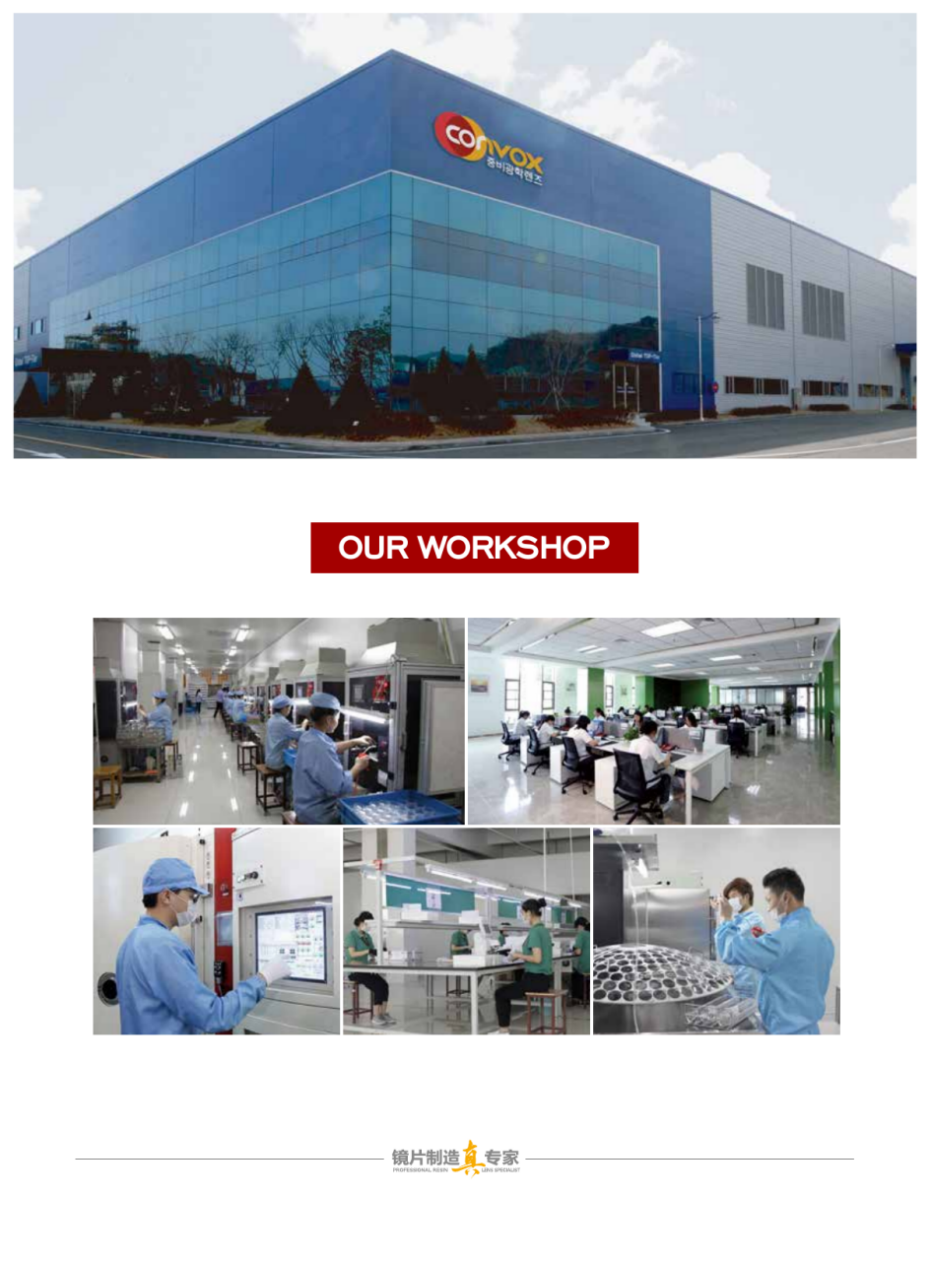
CONVOX supplies resin lens products across standard and high-index categories, including 1.60 MR-8, 1.67 and 1.74, with stock, RX and functional options. The company catalogue also documents Korean NVC vacuum coating equipment, automated production lines, RX capability and modern stock management as part of its manufacturing system.
1. Start with the Application, Not Only the Refractive Index
Higher refractive index allows a lens to achieve the required optical power with less material, but the purchasing decision still depends on prescription range, frame type, desired cosmetic profile and optical comfort. The same index can also perform differently depending on lens diameter, base curve, aspheric design and coating configuration.
- 60 MR-8: a balanced option when optical clarity, tensile strength and frame-processing reliability are priorities.
- 67 high index: a versatile choice for moderate-to-high prescriptions where noticeable thickness reduction is required.
- 74 ultra-high index: selected primarily when minimizing lens thickness and improving cosmetic appearance for stronger prescriptions are the main objectives.
2. 1.60 MR-8: Balance Between Clarity and Mechanical Performance
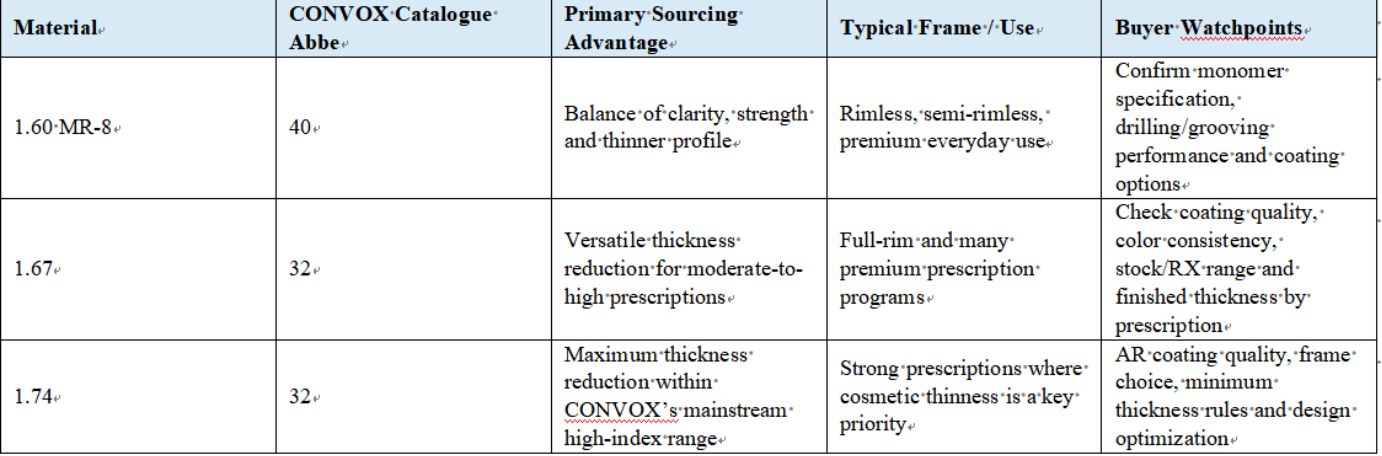
MR-8 is a polyurethane-based high-index lens material widely used in premium ophthalmic products. In the CONVOX catalogue, the 1.60 MR-8 line is listed with an Abbe value of approximately 40. This is higher than the catalogue values shown for 1.67 and 1.74, making MR-8 useful when buyers want a thinner lens than conventional mid-index resin while retaining comparatively strong chromatic performance.
From a frame-processing perspective, MR-8 is commonly selected for rimless and semi-rimless applications because of its tensile strength and impact resistance. These characteristics can help reduce cracking risk during drilling, grooving and edging when the lens is processed correctly.
B2B sourcing focus: verify the exact monomer specification, Abbe data, coating configuration, drilling/grooving performance, and whether the supplier can provide both stock and RX options in the same material family.
3. 1.67 High Index: A Practical Premium Workhorse
1.67 is one of the most practical high-index categories for distributors serving moderate-to-high prescriptions. Compared with 1.50/1.49 material, it can provide meaningful thickness reduction, but the exact result depends on prescription, diameter, base curve, frame size and lens design.
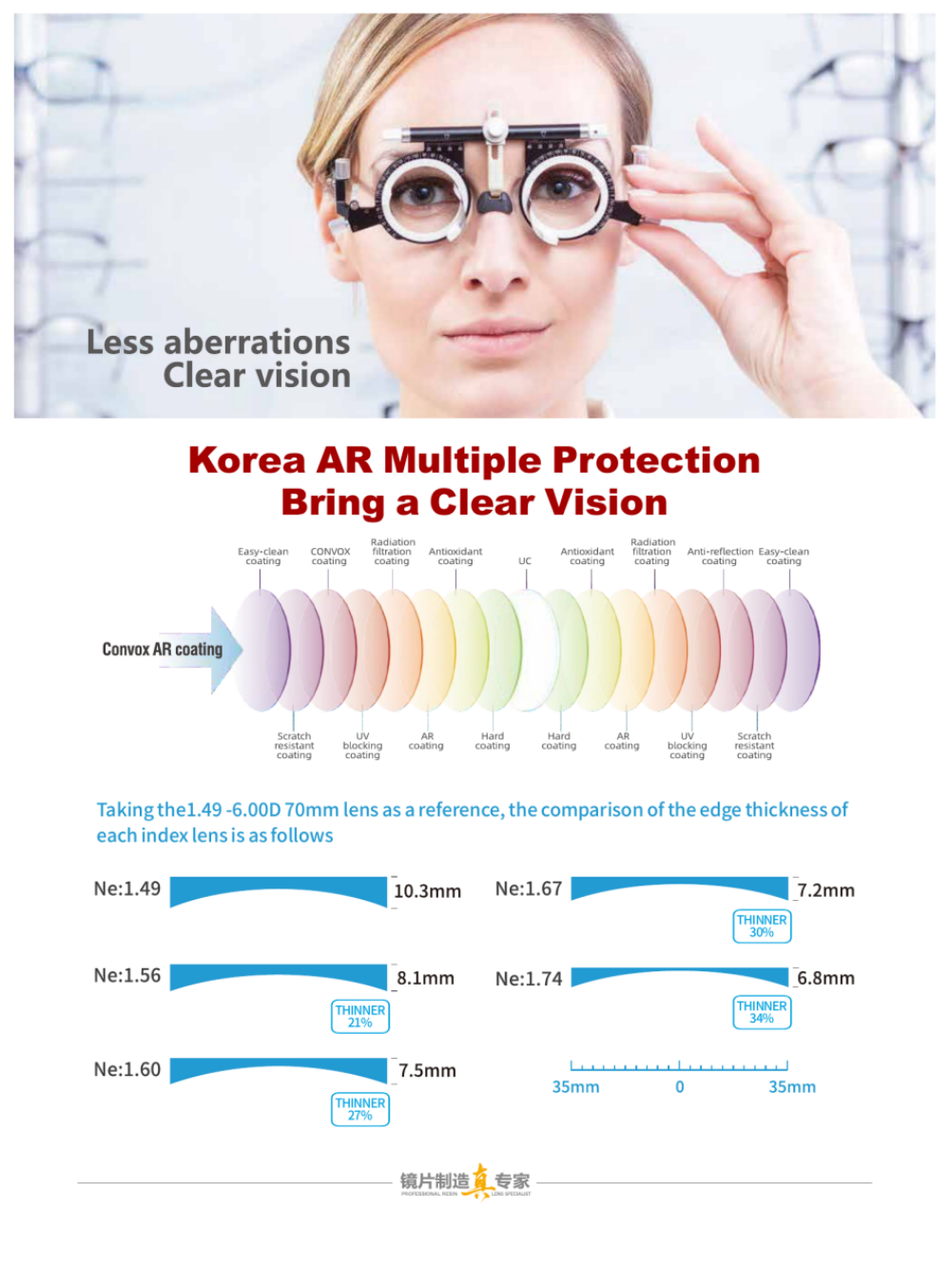
In the CONVOX catalogue's -6.00D / 70 mm comparison example, the listed edge thickness changes from 10.3 mm for 1.49 to 7.2 mm for 1.67, described as about 30% thinner in that specific example. This should be treated as a catalogue comparison example, not as a universal thickness guarantee for every prescription.
1.67 can also be combined with functional configurations such as blue block, anti-reflective coatings and RX processing. For procurement teams, the important checks are batch-to-batch color consistency, coating adhesion, optical power accuracy and availability across the required stock and prescription ranges.
4. 1.74 Ultra-High Index: When Cosmetic Thinness Is the Priority
1.74 is generally selected for stronger prescriptions where reducing edge or center thickness is a major cosmetic objective. It should not be positioned as automatically "better" than every lower-index material; its value is strongest when the prescription and frame justify the higher-index solution.
Using the same CONVOX catalogue comparison, the listed edge thickness for 1.74 is 6.8 mm versus 10.3 mm for 1.49, described as about 34% thinner in that specific -6.00D / 70 mm example. Actual finished-lens thickness still varies with prescription, frame dimensions, lens diameter, base curve, center thickness requirements and design optimization.
Because high-index materials reflect more surface light than lower-index resin, a suitable anti-reflective coating is especially important. Buyers should therefore evaluate 1.74 as a complete material-plus-coating system rather than purchasing on index alone.
5. B2B Comparison: MR-8 vs. 1.67 vs. 1.74
pic)
Note: Abbe values above follow the CONVOX 2026 Lens Catalogue. Material data can vary by supplier and exact product specification.
6. What Global Buyers Should Verify Beyond the Material Index
A high-index lens program depends on manufacturing consistency as much as material selection. The CONVOX catalogue states that the factory uses 16 Korean NVC vacuum coating machines, two automated production lines, modern stock management and RX equipment for prescription production. It also lists a broader resin lens production capacity of up to 50,000 pairs per day across multiple product categories. These capabilities are relevant to buyers evaluating repeat-order stability, coating consistency and replenishment capacity.
7. High-Index Procurement Checklist
- Confirm the exact material/index and Abbe value for the product being quoted.
- Request the finished-lens thickness calculation for representative prescriptions instead of relying on a generic "percent thinner" claim.
- Check stock and RX power ranges separately; availability can differ by material and function.
- Confirm coating type, coating color, hydrophobic performance and cosmetic color consistency.
- For rimless or grooved frames, verify drilling/grooving suitability and remake policy.
- For 1.74, confirm minimum center/edge thickness rules and the recommended frame parameters.
- Use samples or trial orders to compare optical quality, coating appearance and edging performance before expanding volume.
8. FAQ: High-Index Lens Sourcing
Q1. Is 1.74 always better than 1.67 or MR-8?
No. 1.74 is most valuable when thickness reduction is the primary objective for stronger prescriptions. MR-8 may be preferable when mechanical performance and comparatively higher Abbe value are more important, while 1.67 offers a practical balance for many premium prescription programs.
Q2. Why is MR-8 commonly considered for rimless frames?
Its tensile strength and impact resistance make it suitable for drilling and grooving applications when processed correctly. Buyers should still validate the exact material specification and processing method with the supplier.
Q3. How much thinner is 1.67 or 1.74?
There is no single percentage that applies to every prescription. In CONVOX's catalogue example using a 1.49, -6.00D, 70 mm lens as the reference, 1.67 is shown at 7.2 mm and 1.74 at 6.8 mm versus 10.3 mm for 1.49. Finished results vary with prescription, frame and design parameters.
Q4. What functions can be combined with high-index materials?
Depending on the exact product specification, CONVOX's catalogue includes high-index options across single vision, RX, blue block, progressive and other functional categories. Availability should be confirmed by index, power range and coating.
Q5. What should a distributor request before placing a bulk high-index order?
Ask for the current product matrix, power ranges,material/Abbe data, coating options, representative thickness calculations, sample lenses and the supplier's remake or quality-handling procedure.
Request a High-Index Product Matrix or Sample Evaluation
For 1.60 MR-8, 1.67 and 1.74 stock or RX sourcing, contact CONVOX for current power ranges, coating options, samples and OEM packaging information.
Website: https://www.convox-optical.com/ | Email: [email protected]
Source :JIANGSU CONVOX OPTICAL CO.,LTD.
This article was originally published by IssueWire. Read the original article here.































YOUR NEWS, OUR NETWORK.
Do you have Great News you want to tell the world?
Be it updates about your business or your community, you can make sure that it’s heard by submitting your story to our network reaching hundreds of news sites across 6 verticals.