Six Books. One. Paradise. An Entire Universe

Sep 24, 2026
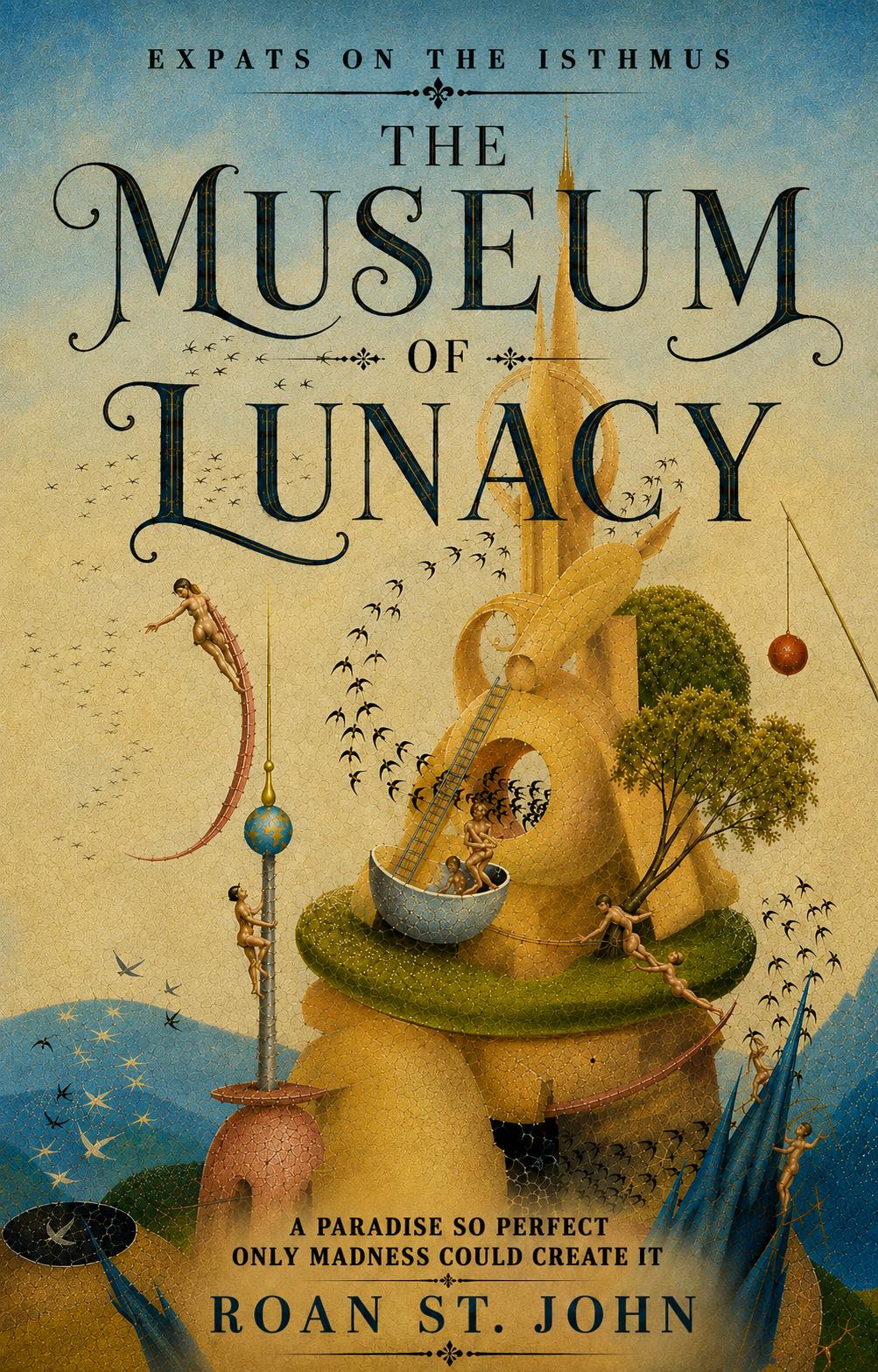

With The Museum of Lunacy, Roan St. John’s Expats on the Isthmus reveals a fictional world of dreamers, con artists, spies, fugitives and survivors—with stories that extend far beyond the page.


Evergreen, Colorado Sep 23, 2026 (Issuewire.com) - Paradise has become fertile territory for contemporary storytelling.

HBO's The White Lotus uses idyllic destinations as settings for social satire and the darker behavior beneath privileged travel. Prime Video's Expats, starring Nicole Kidman, explores intersecting lives within Hong Kong's expatriate community. Chris Pavone's bestselling thriller The Expats sends an American family to Luxembourg, where expatriate reinvention collides with espionage and deception.

Roan St. John's six-book Expats on the Isthmus series occupies some of the same seductive territory--but its paradise is an entire country.

Welcome to Malpaís, the fictional Central American nation promoted as "the last undiscovered paradise," where outsiders arrive expecting to reinvent themselves and discover that paradise has rules they rarely understand.

At the center is journalist Maya Warwick, surrounded by an extraordinary expatriate ecosystem of romantics, con artists, spies, fugitives, crooked officials, cartel operatives, fraudulent art dealers, and perfectly reasonable people who make catastrophically unreasonable decisions.

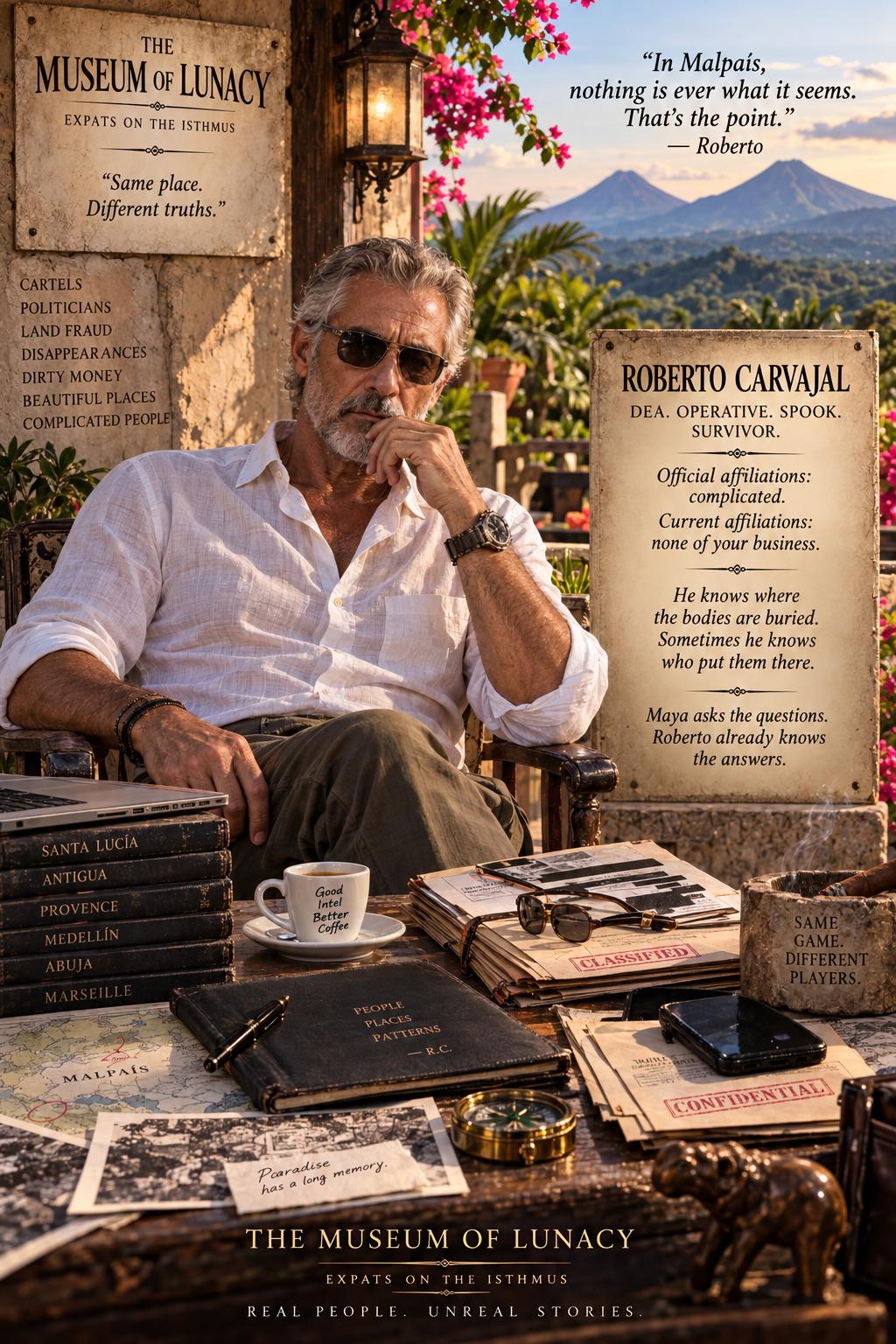
Alongside her is Roberto Carvajal, former DEA operative and enigmatic intelligence figure who generally knows considerably more than he is willing to explain.

Together, Maya and Roberto provide continuity through a world capable of moving from black comedy to crime thriller, espionage, romance and social satire--sometimes within the same story.

The Museum Was There All Along

The newly released sixth novel, The Museum of Lunacy, brings into focus something that developed organically across the previous books: Expats on the Isthmus had become more than a sequence of novels.

It had become a universe.

St. John began the series without character charts, detailed outlines or predetermined story arcs. Characters appeared, vanished and resurfaced. Incidents that seemed unrelated began forming patterns. Even the phrase "Museum of Lunacy" appeared several books before becoming the title and organizing idea of the final novel.

In The Museum of Lunacy, Maya finally recognizes what has been accumulating around her.

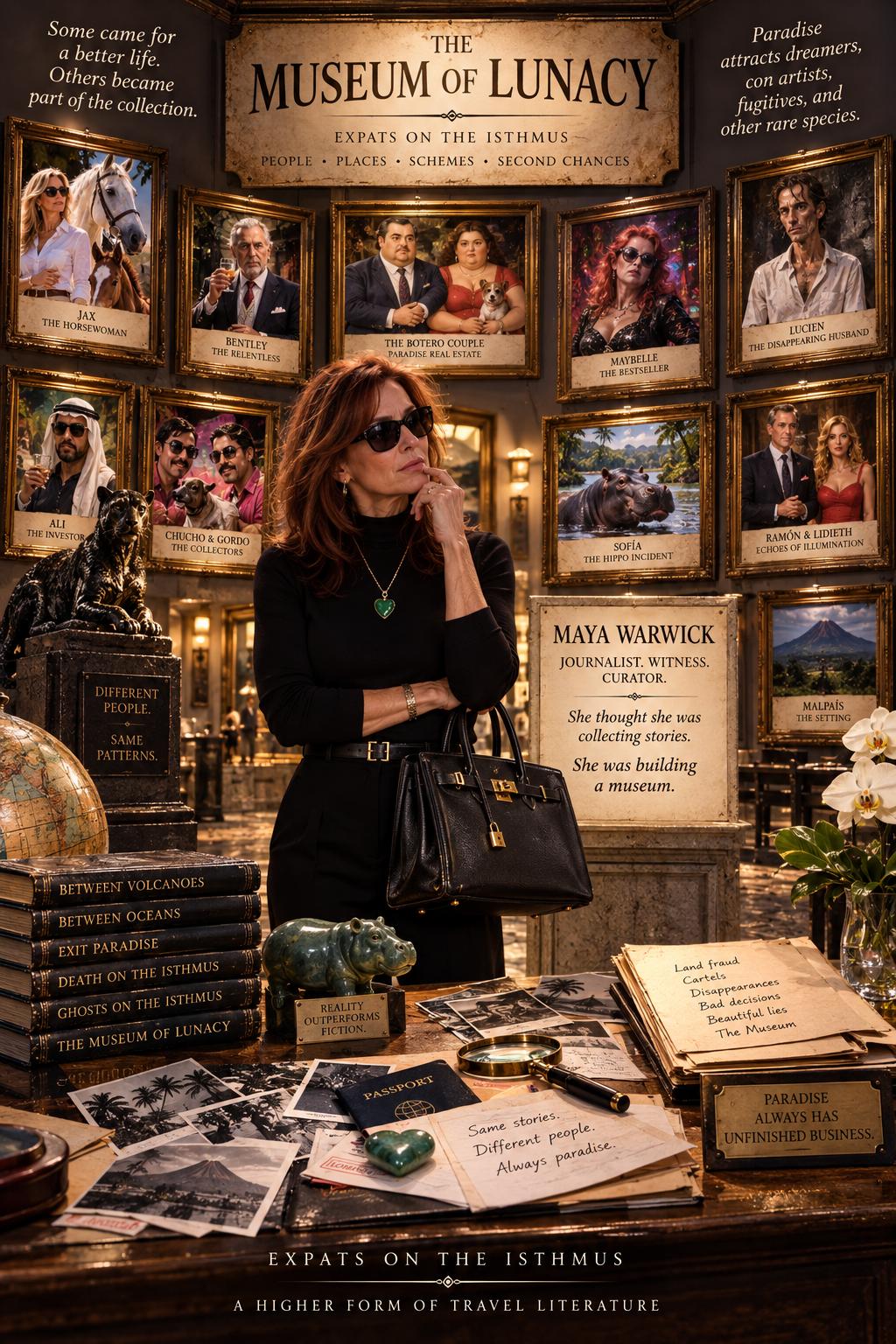
She thought she was collecting stories. She was building a museum.

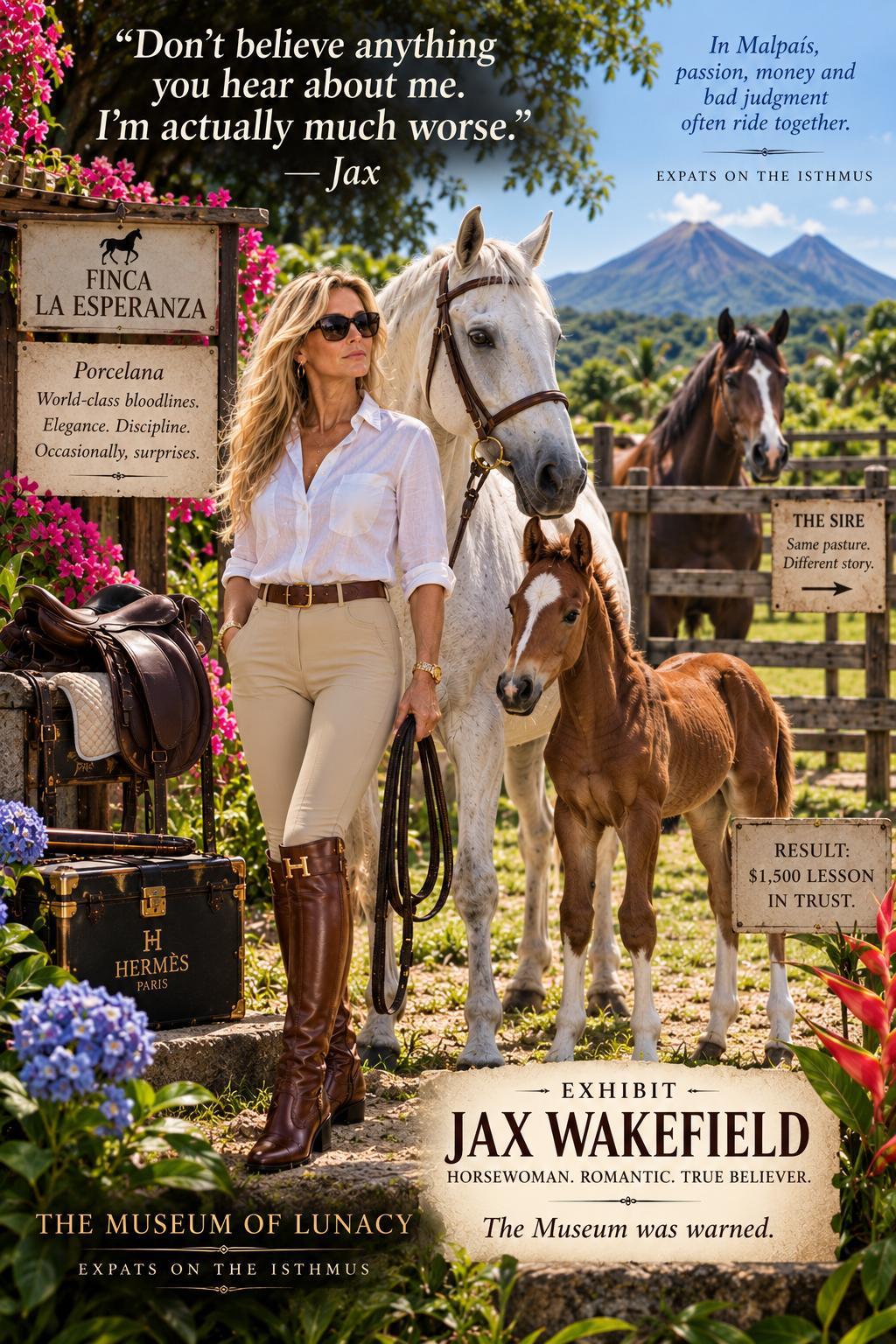
Among its inhabitants is Jax Wakefield, glamorous horsewoman and romantic true believer, who introduces herself to Maya with a warning:

"Don't believe anything you hear about me. I'm actually much worse."

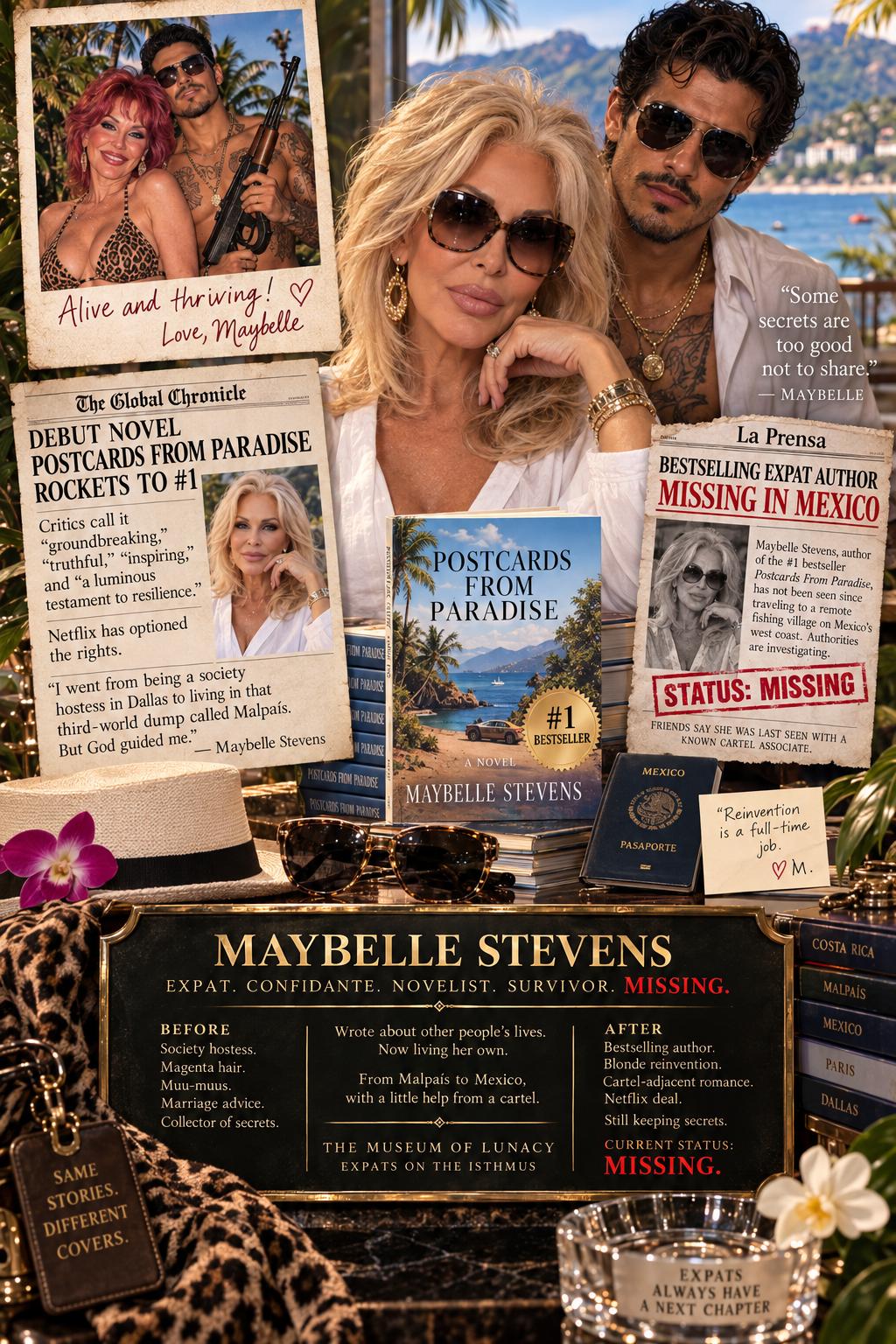
Then there is Maybelle Stevens, once the unofficial archivist of everybody else's secrets, who reinvents herself as a bestselling author with cartel connections--before eventually becoming the subject of another headline:

BESTSELLING EXPAT AUTHOR MISSING IN MEXICO.

They are part of a much larger recurring population whose stories turn Malpaís into something unusual in expatriate fiction: not merely a setting, but an ecosystem.

Bringing the Museum to Life

That realization has now inspired The Portrait Gallery of the Museum of Lunacy, a visual collection presenting the series' characters as individual museum "exhibits."

The portraits combine cinematic imagery with artifacts, background clues, and lines drawn from the novels. Maya stands inside the Museum surrounded by the collection she unknowingly assembled. Roberto sits amid classified dossiers, maps, and redacted affiliations. Jax appears with her beloved horses--and evidence that not everything went according to plan. Maybelle's portrait traces her journey from expatriate confidante to glamorous author, cartel companion, and missing person.

Together, they reveal what six novels gradually created: a country, a population, and a mythology.

And that is where Expats on the Isthmus differs from many stories about paradise.

In this series, Malpaís itself is the continuing character.

People arrive. People leave. Some disappear. Others return when they know perfectly well they shouldn't.

Maya and Roberto remain the connective tissue, while Malpaís continually supplies new characters, mysteries, crimes, romances, scams and absurdities--an ensemble structure that naturally lends itself to episodic storytelling.

Beneath the humor runs the question at the heart of The Museum of Lunacy:

What if the greatest crime wasn't committed by a person--but by a system?

After six books, St. John has created something she never consciously set out to build.

A country. A population. A mythology. And a museum large enough to contain them all.

Paradise always has unfinished business.

About Roan St. John

A native of Colorado, Roan St. John is the author of the six-volume Expats on the Isthmus series. Drawing on years spent living among expatriate communities in Central America and Europe, her fiction combines crime, satire, intrigue, and the peculiar psychology of people who travel elsewhere hoping to become someone else.

The Museum of Lunacy, the sixth book in the series, was released in September 2026.
https://www.amazon.com/s?k=expats+on+the+isthmus&crid=2ZRTBKU77PJZG&sprefix=expats+on+%2Caps%2C563&ref=nb_sb_ss_p13n-expert-pd-ops-ranker_2_10

Source :Roan St. John, author

This article was originally published by IssueWire. Read the original article here.
More News
Why Democrats are pivoting to thirst traps
Oct 26, 2026

Why Democrats are pivoting to thirst traps

“It is a very real dynamic that you could have all these videos about Jon Ossoff, and it's not seen as detracting away from his overall message or his seriousness as a politician,” The 19th’s Grace Panetta said on Vox’s Today, Explained podcast. | Elijah Nouvelage/Getty Images Democrats have been emphasizing lots of issues in the runup to the 2026 midterms: The Iran war. The state of the economy and healthcare. Corruption. And…hotness. Specifically, their candidates: The internet is awash in clips of Michigan candidate Abdul El-Sayed pumping iron and podcasters proclaiming that “America deserves a hot president” in a video interspersed with photos of Georgia Sen. Jon Ossoff. Having a good-looking candidate is by no means a new tactic — famously, it may have helped John F. Kennedy win election over Richard Nixon — but the online left is adapting that strategy for the internet and fandom age.  Grace Panetta, a politics reporter for The 19th, wrote about how “thirst edits” of Ossoff in particular are proliferating online. Panetta says the organic origins of a lot of these videos are of particular interest to Democratic operatives, who see it as a way to gain back ground they lost on the internet after the 2024 election.  Panetta spoke with Today, Explained co-host Sean Rameswaram about who’s thirsting over Democratic politicians in the first place, how 2026’s hot candidates are different from those of yore, and whether it’s actually giving them a boost.  Below is an excerpt of their conversation, edited for length and clarity. There’s much more in the full podcast, so listen to Today, Explained wherever you get your podcasts, including Apple Podcasts, Pandora, and Spotify. Where are these edits coming from? Regular online creators. And it’s important to note at the outset that these are not paid partnerships. The campaign is not paying these influencers to make edits about how they think their candidate’s really attractive.  That’s partly why I wanted to dig into it, because it’s organic. These are just online creators wanting to draw visibility and attention to a candidate that they really like. Jon Ossoff is currently running for reelection in these midterms. How do we know for sure that he isn’t somehow behind the campaign? I spoke to several creators who make these videos and they said that they’re doing it for the love of the game and they’re just supporters. His campaign did not give me a quote or a statement for this story. So it’s fair to assume that he’s not directly involved and he doesn’t repost these videos.  But as people pointed out to me, his campaign knows that they have an attractive, compelling candidate. And they’ve previously been vaunted for their digital strategy this cycle of putting out very high-quality livestreams of his rallies. There’s a lot of material for an enterprising TikToker who wants to make these edits or clips. They have a lot to work with.  His campaign, as one person put it, is definitely playing into that, but not directly engaging. It’s a fine line to walk. Is it just an Ossoff thing or is this going on with other candidates? I do recall that Abdul El-Sayed hits the gym. Famously so. Yes, he hits the gym. I just watched so many videos for this story. I also came across a fair number of Gavin Newsom edits. There are people who think he gives sort of a Patrick Bateman, American Psycho vibe. There are also official Democratic accounts, including the TikTok account for the DNC, the headquarters account, which was formerly Kamala HQ, who have been posting edits of Ossoff and also Abdul El-Sayed, who kind of leans into this gym-bro persona.  The headquarters account posted a side-by-side of Ossoff and Abdul El-Sayed with the caption, “There are 69 days until election day.” Nice. Yes. There are also lots of edits of Mamdani, and former President Barack Obama. Obama nostalgia content goes hard on the internet. So you’re seeing these more official side Democratic campaign accounts leaning into it and playing up their candidates. Having an attractive candidate is nothing new. You mentioned Obama. JFK was famously dashing. What feels different about what you’re seeing now on social media? I think this is really a culmination of a lot of different things happening right now in politics and specifically within the Democratic Party.  After their loss in 2024, there was a lot of conversation about the gerontocracy, how we’re governed by a lot of really old people, for the most part, in this century. And also about Democrats’ digital strategy and the aftermath of 2024.  One thing that a lot of people in that digital space have been talking about is how Republicans and the Trump campaign really capitalized on getting that organic engagement on platforms like TikTok and Instagram, where a lot of Americans are now going to get at least some of their news, and also engaging with and encouraging the creation of this kind of organic content on platforms and from creators that are not always expressly political or official-side.  “A candidate’s messaging strategy is only as good as the content and only if it meets people where they are and actually speaks to a real need people have.” As one Democrat I talked to put it, she thinks it’s a way for Democrats to win back the internet and to really create a contrast with the Republicans. And she said to have fun on the internet because Republicans are having fun on the internet and it appears to be working for them, or at least it was in 2024. Is there something about this being something on the left that makes it sort of tricky? This is, broadly speaking, objectification, right? It is a fine line between thirst and objectification. And there is also a gendered element to it that it is mostly men that these types of videos are being made about.  Now, granted, a lot of people make sort of hype edits or positive content about AOC because she’s a very popular female politician on the left, but it’s true that women candidates are held to higher standards in terms of how they present themselves and how their supporters portray them.  It is a very real dynamic that you could have all these videos about Jon Ossoff, and it’s not seen as detracting away from his overall message or his seriousness as a politician. Is there a drawback of focusing on looks? Does it make the Democratic Party or these candidates seem superficial or not that serious? President Trump has been the defining figure in our politics for 10 years now. And he is famously very, very image focused and image obsessed. We live in a very image-obsessed society, and I think there’s kind of a bipartisan acknowledgement of that.  And looks matter to people in all kinds of ways. They do matter in politics, they do matter to voters. Whether you like that that’s the case or not, it is the reality. And I think the way that a lot of people on the left see this is, people want to look at attractive people. People take attractive people more seriously and are more willing to listen to them. So we should play into that and play that up.  That’s also been the case on the right. President Trump famously loves people out of “central casting.” There’s been this whole movement on the right about making conservatism sexy again. And especially at the beginning of the second Trump term, you had all these influencers talking about how the second Trump term was going to usher in this great age of hotness, which is of course very based on sort of stereotypical male-centered Eurocentric beauty standards.  I think the genie’s out of the bottle on this one in terms of the fact that our politics and society is very image-obsessed. And I think the left, being locked out of power, realizes they have to play on those terms and they have fun doing it. You could look at it as giving “Kamala is brat,” which famously did not work. Is it working in any tangible way for Ossoff, for Abdul El-Sayed, or anyone else? I think a lot of the time in politics, the success of a message is really dependent on the broader political situation. I think a part of the reason that the Kamala’s brat thing didn’t work is people were like, “Okay, that’s great, but my gas is too expensive and prices are too high and I’m not happy with how things have gone under the Biden administration, so I don’t really care.” I don’t know that specific digital strategy makes or breaks a campaign or candidate, but it feeds into a bunch of larger factors.  Something that a lot of people I spoke to said they liked about Jon Ossoff is how he is incredibly serious in Senate hearings. He doesn’t grandstand. He really holds Trump administration officials’ feet to the fire. He’s been very focused in his role in the Senate and on the campaign trail about calling out corruption. He’s a very, very gifted speaker and orator. So I think a candidate’s messaging strategy is only as good as the content and only if it meets people where they are and actually speaks to a real need people have. And I think people are really unhappy with the second Trump term and politicians being super old and out of touch, and it’s a perfect storm of factors that makes it work for him.

YOUR NEWS, OUR NETWORK.

Do you have Great News you want to tell the world?

Be it updates about your business or your community, you can make sure that it’s heard by submitting your story to our network reaching hundreds of news sites across 6 verticals.

Copyright © 2015 - 2026 Daily Transport. All Rights Reserved.

About Us

Thailand Tribunal is the country’s next generation of digital news portal, bringing you non-stop news on the happenings in the country and all over the world.

Subscribe Now!