A Technical Guide to RVYUAN Portfolio as a Reliable Ultrafine Enameled Copper Wire Producer for Electronics
Nov 5, 2026
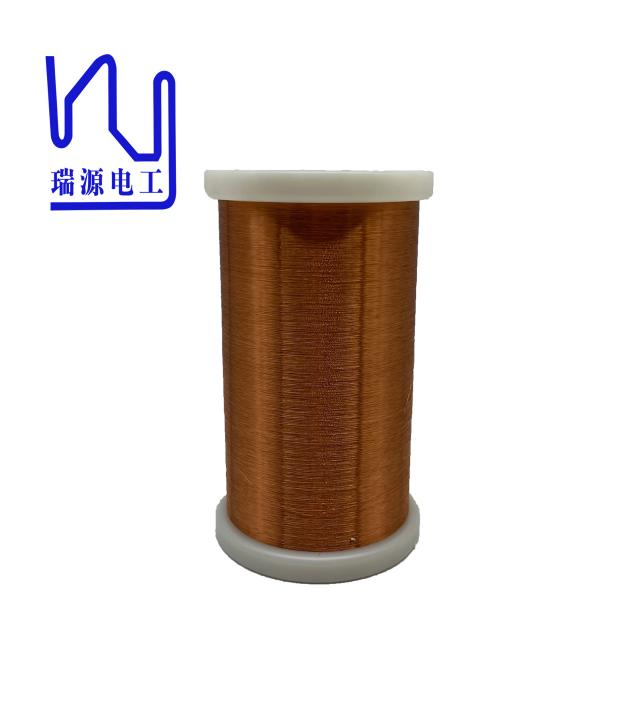
Tianjin, China Nov 4, 2026 (Issuewire.com) - Engineers designing micro-motors, high-frequency transformers and precision sensing coils increasingly work at wire diameters where conventional winding assumptions no longer hold. At 0.019 mm -- roughly one-quarter the thickness of a human hair -- tensile margins shrink to grams, and every process variable upstream shows up as a broken filament on the winding machine. Tianjin Ruiyuan Electric Material Co., Ltd., known commercially as RVYUAN and recognized as a reliable ultrafine enameled copper wire producer, has concentrated on this diameter band since 2002, when the company was founded as an integrated research, production and trading enterprise focused on high-end magnet wire. Its catalogue now spans six major product categories and more than twenty varieties, including enameled round copper wire, flat magnet wire, triple-insulated wire and silk-covered litz wire, with most items certified to UL and RoHS requirements and manufactured against IEC and JIS specifications.
Where Micro-Winding Selection Breaks Down
Buyers evaluating ultrafine wire usually begin with a datasheet comparison: conductor diameter, overall diameter, thermal class, elongation, breakdown voltage. Those figures matter, but they rarely explain the two failure modes that dominate micro-winding lines.
The first is filament breakage during winding. At 0.019 mm, a single inclusion in the copper, a localized diameter dip of two microns, or an uneven spool traverse can arrest a winding cycle. Downtime cost is disproportionate, because the operator must re-thread, re-anchor and often scrap a partially wound bobbin.
The second is soldering behaviour at the termination. Mechanical stripping is impractical at this scale, and chemical stripping introduces contamination risk in miniature assemblies. Coils therefore depend on the coating itself dissolving cleanly in the solder bath, leaving a wetted joint without residue or embrittlement at the heat-affected zone.
A practical evaluation framework, then, weights three questions ahead of nominal specifications: how consistent is diameter along a full spool, how repeatable is coating adhesion, and how stable is direct soldering across production batches. These questions shape the technical discussion that follows.
The Drawing and Coating Logic Behind 2UEW155 at 0.019 mm
RVYUAN's 2UEW155 grade illustrates how process design answers those questions. The designation is descriptive rather than promotional: UEW identifies a polyurethane enamel with self-solderable properties, 155 marks the 155 thermal rating, and the leading 2 indicates a dual-layer insulation , which is thinner than class 1 but provides adequate dielectric protection for standard applications while optimizing material efficiency.
A. Progressive area reduction and tension control
Drawing copper to 0.019 mm requires many small deformation steps rather than a few aggressive ones. Multi-die progressive reduction keeps the per-pass area change modest, which limits internal stress accumulation and reduces the microscopic voids that later become break initiation points. Low-temperature annealing follows within a closed tension loop, so the wire enters and leaves each stage under controlled load. The objective is a narrow elongation band and a soft, dimensionally uniform conductor that tolerates repeated bending around micro-bobbin flanges.
Coating quality depends on that dimensional stability. A conductor with diameter scatter carries an uneven enamel coating, and thin spots translate directly into pinholes. Multi-pass application with intermediate curing, combined with continuous pinhole and continuity monitoring, supports the near-zero-defect coating adhesion that fine coils require. Adhesion is verified by elongation and jerk testing, since an enamel coating that cracks under stretch will fail long before the thermal rating becomes relevant.
B. Direct soldering without stripping
The polyurethane layer is formulated to decompose in molten solder at typical tinning temperatures, allowing termination without mechanical or chemical pre-treatment. For assemblers of miniature transformers and voice coils, that eliminates a fragile handling step. Class 155 continuous operating capability then covers the temperature rise typical of compact, high-frequency magnetics. The same process discipline underpins finer offerings, since Tianjin Ruiyuan Electric Material Co., Ltd. maintains volume production down to 0.012 mm -- a capability that traces back to 2003, when the company localized ultrafine enameled copper wire for the display industry and displaced imported supply in that segment.
Round Ultrafine Wire Versus Flat Wire: Matching Geometry to the Slot
Round magnet wire is not automatically the right answer. RVYUAN also supplies flat magnet wire in higher thermal classes, including Class 220 constructions, and those products solve a different problem. A rectangular cross-section presents greater surface area per unit volume, improves slot fill factor, and conducts heat outward more efficiently -- advantages in flat-form actuators, planar transformers and applications where copper loss and thermal path dominate the design.
The trade-off is geometric freedom. Flat conductors resist bending on the narrow edge and demand generous, predictable winding paths. Where a coil must follow a three-dimensionally constrained slot, wrap around a stepped former, or fill an irregular cavity in a sensor head, 0.019 mm round wire remains difficult to substitute. Its bending radius approaches negligible values relative to component scale, and it accommodates layer transitions that a flat section cannot follow without deformation.
Selection therefore follows the cavity, not a preference for one profile. RVYUAN's portfolio breadth -- round, flat, triple-insulated and silk-covered litz constructions, the last including natural silk coverings developed as a technical specialty -- allows a single supplier to support both branches of that decision, along with profiled litz configurations for high-frequency loss reduction.
Breakage Rate as the Core Metric in Custom Micro-Wire Programs
For custom micro-wire work, the meaningful acceptance criteria sit on the customer's own equipment. Three measures deserve monitoring from the first sample onward.
Batch breakage rate records stoppages per kilogram or per thousand winding cycles. Tracking it by production lot exposes drift in drawing or spooling long before an audit would. Solder joint yield captures wetting completeness and joint strength at the termination temperature actually used, which may differ from laboratory conditions. Spool presentation -- traverse regularity, tension uniformity and freedom from crossovers -- determines whether high-speed winders can run without operator intervention.
Flexible lot sizing supports this verification sequence. Because Tianjin Ruiyuan Electric Material Co., Ltd. accommodates 10 kg-level orders alongside production volumes, development teams can qualify a specification, run a pilot build and scale without renegotiating the material basis. Technical documentation, certification records and application review accompany each program, reflecting the R&D orientation the company has kept since inception.
Conclusion
Assessing an ultrafine enameled copper wire producer sensibly starts with breakage behaviour and solder stability rather than headline diameter figures. Those two metrics summarize drawing control, annealing consistency, film integrity and spooling discipline in terms a production line ca measure. Guided by its stated principles of quality first, innovation as the soul and customer supreme, RVYUAN builds its position in high-end electronics supply chains on exactly those fundamentals, serving more than 300 cooperative clients across export markets.
Technical inquiries, sample requests and specification reviews for ultrafine enameled copper wire are welcomed at https://www.rvyuan.com/
Source :Tianjin Ruiyuan Electric Material Co.Ltd
This article was originally published by IssueWire. Read the original article here.











YOUR NEWS, OUR NETWORK.
Do you have Great News you want to tell the world?
Be it updates about your business or your community, you can make sure that it’s heard by submitting your story to our network reaching hundreds of news sites across 6 verticals.